

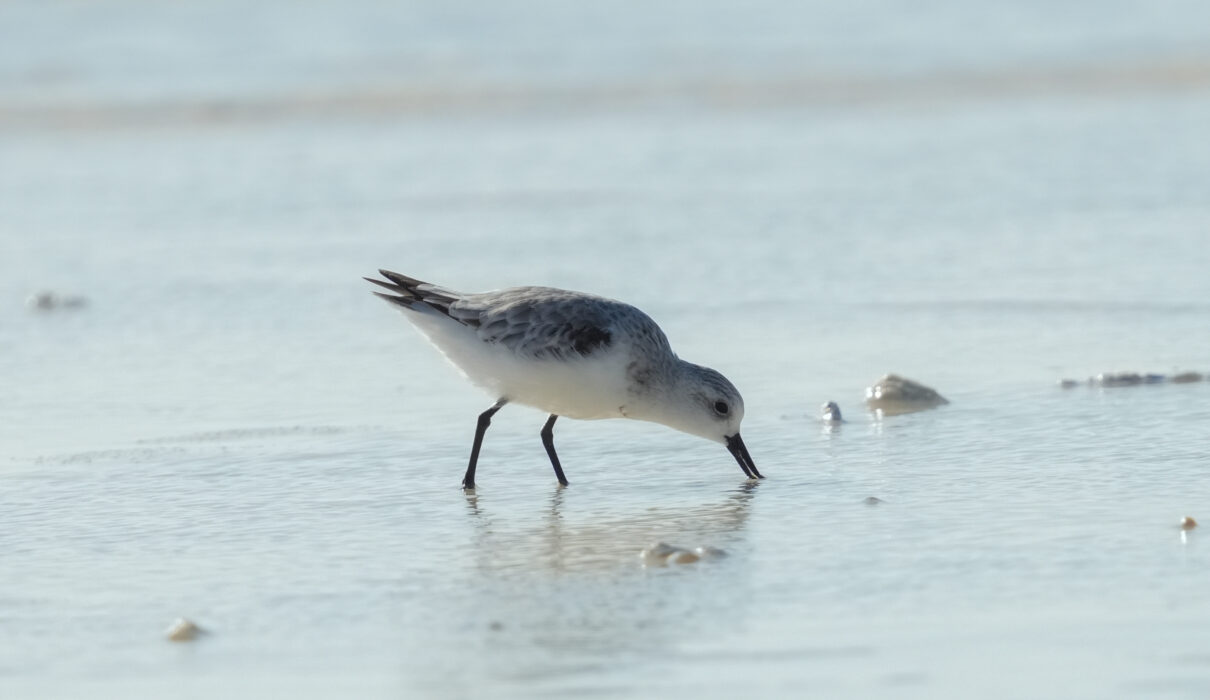
Imagine a creature weighing no more than a couple of chocolate bars—roughly 50 to 100 grams—undertaking a multi-thousand-mile voyage across continents, towering mountain ranges, and vast, unforgiving oceans. This is the reality of the Sanderling (Calidris alba), one of the natural world’s most astonishing endurance athletes.
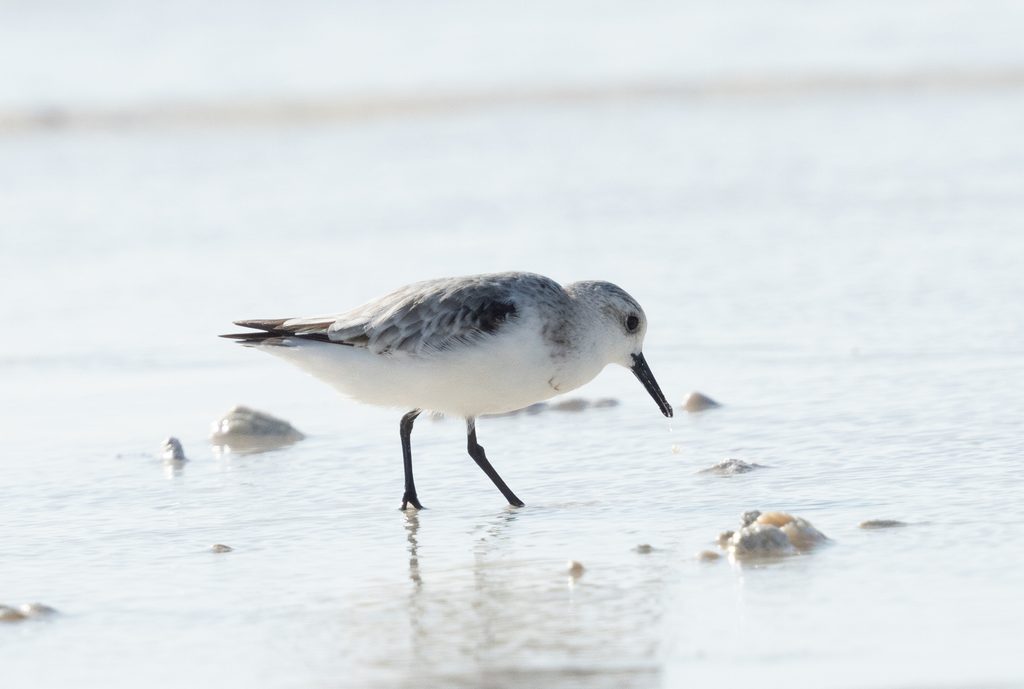
Every year, these small, pale-grey sandpipers leave the frozen, windswept high-Arctic tundra and fly thousands of miles south to winter on tropical shores, including the pristine, sun-drenched sandbanks and intertidal zones of the Maldives. Their journey is a masterclass in avian survival, physiological engineering, and navigational genius.
The Migration Route: From the Top of the World to the Indian Ocean
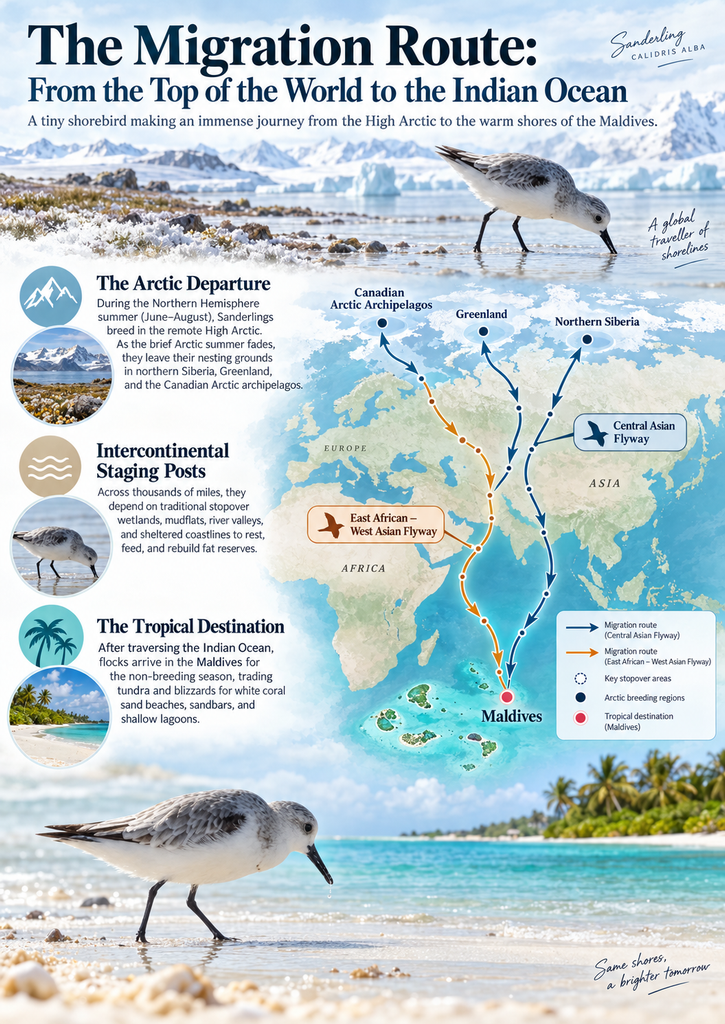
Sanderlings are true cosmopolitans of the shorebird world, boasting one of the widest non-breeding distributions of any wader. During the Northern Hemisphere summer (June to August), they breed in the remote, rocky highs of the High Arctic. However, as soon as the brief Arctic summer fades and ice begins to grip the tundra, they embark on a massive southward exodus.
Those that find their way to the Maldives typically navigate along the Central Asian and East African-West Asian flyways.
- The Arctic Departure: They leave their nesting grounds in northern Siberia, Greenland, and the Canadian Arctic archipelagos just as conditions turn hostile.
- The Intercontinental Staging Posts: Flying over thousands of miles of open land, interior steppes, river valleys, and coastlines, they rely on traditional stopover wetlands, mudflats, and sheltered coastlines to rest, feed, and rebuild their fat reserves.
- The Tropical Destination: Traversing the vast, open expanse of the Indian Ocean, flocks of Sanderlings finally arrive in the Maldives. Instead of enduring sub-zero blizzards, they trade the tundra for blindingly white coral sand beaches, sandbars, and shallow lagoons where they spend the non-breeding season in warmth and abundance.
How Do They Survive the Long-Way Journey?
Flying thousands of miles non-stop over land and sea requires specialized biological adaptations that push the boundaries of vertebrate physiology. A migrating Sanderling is essentially built like a high-performance aircraft:
1. The Ultimate Fuel Tank (Hyperphagia and Fat Loading)
Weeks before departure, Sanderlings undergo hyperphagia—a massive, instinctual feeding frenzy. They gorge themselves on marine worms, insects, and tiny crustaceans. In a remarkably short window, they can almost double their body weight, packing pure fat beneath their skin. This fat acts as high-octane “aviation fuel” that powers their continuous flapping and gliding across thousands of miles of non-stop flight.
2. Radical Organ Shrinking and Reshaping
To maximize aerodynamic efficiency, a migrating bird’s body undergoes structural transformations that sound like science fiction. Before embarking on a long-haul flight, Sanderlings actually shrink non-essential internal organs—such as their digestive tract, since they won’t be eating mid-air—to significantly lighten their load. Conversely, they enlarge their heart muscles and pectoral (chest) muscles to maintain relentless, rhythmic wing-beats over thousands of kilometers.
3. Night Navigation and Weather Mastery
Sanderlings frequently initiate their longest flights at dusk or night. Flying under the cover of darkness helps them avoid avian predators like falcons, keeps the surrounding air cooler (which minimizes dangerous dehydration), and utilizes stable atmospheric conditions. They navigate with precision using a combination of cues:
- The position of the setting sun and polarized light patterns.
- The night sky and constellations.
- Earth’s magnetic field, detected via specialized proteins (cryptochromes) in their eyes.
- Topographical landmarks and coastlines mapped deep into their genetic memory.
Feeding on the Edge: Life on Maldivian Shores
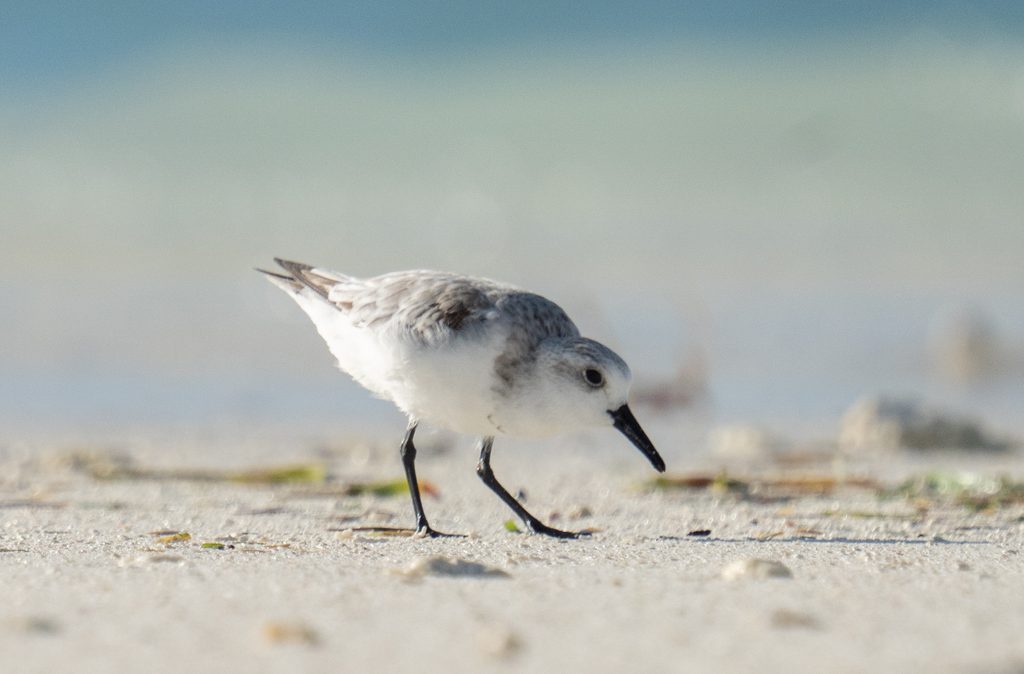
When Sanderlings finally touch down on Maldivian beaches, they waste no time settling in. They are immediately recognizable by their frantic, high-speed, clockwork behavior.
True to their reputation as the energetic dynamos of the shore, they run back and forth along the shoreline in synchronized flocks. As a wave recedes, they dash down the wet sand to rapidly probe for microscopic crabs, mollusks, and marine invertebrates left exposed. The split-second the next wave rolls in, they scatter upward on blurry little legs, keeping their plumage dry and effortlessly avoiding the wash.
Did You Know? Despite weighing next to nothing, a Sanderling can live up to 13 years in the wild. This means an individual bird might rack up over 100,000 miles of total flight distance across its lifetime—equivalent to flying to the Moon and a significant fraction of the way back!
Conclusion: A Fragile Global Connection
The journey of the Sanderling bridges two vastly different, yet intimately connected worlds: the frozen, silent Arctic and the vibrant, turquoise coral islands of the Maldives. Their seasonal presence on tropical shores serves as a powerful reminder of nature’s interconnectedness—proving that a tiny bird hatched on top of the world depends entirely on the health, protection, and preservation of distant coastlines to complete its timeless, epic marathon.

